

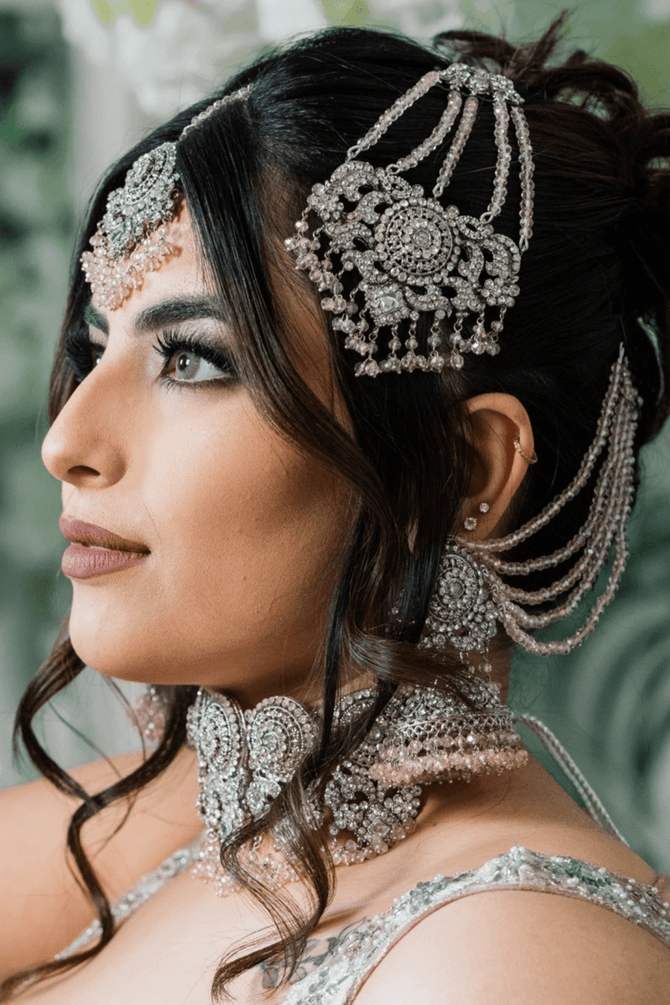


A love letter to the most iconic earring in human history.
Let's be real. You have worn jhumka earrings to a shaadi, a mehendi, a jaggo, a mayun, and to a family dawat. Probably to a Zoom call where only your face was visible. At least once, you wore them to a Target run because the fit demanded it. No judgment. Actually, full judgment, the correct judgment that you have impeccable taste.
Because here is the thing nobody tells you. You are standing in front of the mirror, jhumkas tangled in your dupatta again. Those earrings you are wearing have survived the fall of empires. They outlasted the Mughal dynasty and two world wars. They outlasted the decline of the CD and the entire era of clip-on earrings. They are, without exaggeration, one of the most enduring design objects in human history.
So the next time someone asks why you are wearing "such big earrings," you can inform them otherwise. You are, in fact, wearing a piece of living history that is approximately 2,300 years old. You are basically at a museum. A very glamorous, very loud museum.
Table of contents
- 1. Quick Answer: What Are Jhumka Earrings?
- 2. The Origin Story: When Ancient Sculptures Were the First Jhumka Girls
- 3. The Mughal Glow-Up: When the Court Got Involved
- 4. Regional Dialects of the Jhumka Across South Asia
- 5. The Bollywood Seal of Approval (Which Was Inevitable)
- 6. The Diaspora Chapter: Your Jhumkas Crossed Borders Too
- 7. How to Style Jhumkas in 2026
- 8. The Jhumka Breakdown: Which Style Is Right for You?
- 9. How to Care for Your Jhumkas
- 10. Can Anyone Wear Jhumka Earrings?
Quick Answer: What Are Jhumka Earrings?

Let's be real. You have worn jhumka earrings to a shaadi, a mehendi, a jaggo, a mayun, and to a family dawat. Probably to a Zoom call where only your face was visible. At least once, you wore them to a Target run because the fit demanded it. No judgment. Actually, full judgment, the correct judgment that you have impeccable taste.
Because here is the thing nobody tells you. You are standing in front of the mirror, jhumkas tangled in your dupatta again. Those earrings you are wearing have survived the fall of empires. They outlasted the Mughal dynasty and two world wars. They outlasted the decline of the CD and the entire era of clip-on earrings. They are, without exaggeration, one of the most enduring design objects in human history.
So the next time someone asks why you are wearing "such big earrings," you can inform them otherwise. You are, in fact, wearing a piece of living history that is approximately 2,300 years old. You are basically at a museum. A very glamorous, very loud museum.
Before we get into the full 2,300-year saga, here is the short version for anyone who came here from Google:
Jhumka earrings (also spelled jhumki, jhumkis, or jumka) are traditional South Asian bell-shaped earrings originating from ancient India. The word "jhumka" is onomatopoeic, named for the gentle jhum jhum sound they make with every movement. They are hollow and dome-shaped, which makes them lighter than they look. They swing and sway with you. They are deeply embedded in the cultural traditions of India, Pakistan, and Bangladesh. They have been worn continuously for over 2,300 years. They are the most iconic earring in South Asian jewelry history.
And yes, they go with absolutely everything.
They have survived empires, partitions, and the dreaded aunties' styling opinions. They are the ultimate jewelry survivor.
But to understand why protecting that survival matters, we have to call out the audacity happening on Western runways right now. At Ralph Lauren's Fall 2026 show at Paris Fashion Week, models wore dome-shaped, bell-like silver earrings that were unmistakably jhumkas. The brand described them as "vintage accessories" with zero reference to South Asian jewelry traditions. They credited Native American collaborators in the same collection. South Asia did not get a mention. They want the physics of the swing. They do not want the weight of the heritage.
You can rename the silhouette. You cannot rename the soul. To understand why this design is utterly unerasable, you have to look back at where it actually started, long before it ever hit a corporate mood board.
The Origin Story: When Ancient Sculptures Were the First Jhumka Girls

Here's where the timeline gets genuinely wild.
The earliest depictions of jhumka earrings trace back to ancient temple sculptures from the Chola dynasty, circa 300 BCE, in South India. That is not 200 years ago. That is not even 500 years ago. That is over two thousand three hundred years ago.
The Chola dynasty ruled much of South India and at its height extended its naval power to Southeast Asia. The dynasty was famous for breathtaking architecture and stone sculpture. In those historic monuments, carved architectural figures were adorned with bell-shaped earrings as a mark of the highest elite status. Jewelry in this context was not simple vanity. It was a tribute to human craftsmanship and artistic dedication. Ancient sculptures wore jhumkas first. Mortals followed, as they do. You can explore the Chola dynasty's extraordinary artistic legacy at the British Museum's South Asia collection.
Classical court dancers wore these exact same intricate designs during their elaborate performances. As the earrings moved with their choreography, the jhumka gained an entirely new kinetic meaning. It became associated not just with stone architecture, but with fluid grace, femininity, and performance artistry. The jhumka is embedded in the very foundations of classical dance forms including Bharatanatyam and Kuchipudi. The earring is not a passive accessory. It performs alongside you.
The Gupta and Maurya empires (roughly 320 BCE to 550 CE) then leveled things up. They introduced precious stones including rubies and pearls into the design, marking the shift from structural architectural art to an undeniable symbol of royal standing, wealth, and high fashion.
The Mughal Glow-Up: When the Court Got Involved

If the Chola period was the jhumka's origin story, the Mughal era (1526 to 1857 CE) was its main character arc.
The Mughal Empire, a dynasty of Central Asian origin that ruled across the Indian subcontinent, was obsessed with beauty in the most productive way possible. The emperors from Akbar to Shah Jahan were intense patrons of the arts. Yes, Shah Jahan built the Taj Mahal as a literal grief project. Dramatic. Iconic. Not the point right now. Their court brought together Indian craftsmanship and Persian artistry and the result was some of the most extraordinary jewelry the world has ever produced.
The Mughals transformed jhumka design by introducing enamel work, floral motifs, and intricate filigree. They are credited with developing meenakari, the art of enameling metal with rich, vivid colors. They advanced kundan work, the technique of setting gemstones in pure gold. They refined polki jewelry, using flat, uncut diamonds. All of these became defining features of the jhumka styles still revered today. The Victoria and Albert Museum holds one of the finest collections of Mughal jewelry in the world if you want to go deep.
The Mughals also gave the jhumka a structural upgrade. Jewelers developed the karnphool, literally "ear flower," a statement stud featuring pearls, uncut diamonds, and gemstones. This was often connected by a delicate chain called sankali that ran up through the hair, fixed with a small hook. The whole ensemble was dramatic and intentional. Queens of the Mughal court wore heavy jewelry throughout the day. The jhumka's hollow construction was a practical genius move: it looked incredibly ornate while being surprisingly lightweight. Smart and gorgeous. Generational queen behavior.
Regional Dialects of the Jhumka Across South Asia
One thing the diaspora does not always know: the jhumka is not one singular thing. It speaks multiple regional languages, and every community on the subcontinent has claimed it as its own.
West Bengal and Bangladesh: Known as the jhumko (ঝুমকো), this version is crafted using elaborate filigree and granulation techniques, featuring floral and paisley patterns. It is central to the bridal trousseau across both Bengali Hindu and Muslim traditions and remains one of the most recognizable earring silhouettes in the region.
Rajasthan: The karanphool style pairs a flat floral disc with a hanging jhumka drop, often decorated with meenakari enamel in jewel tones of green, red, and blue. The word karanphool translates literally to ear flower, and the design lives up to the name.
Tamil Nadu: The jimikki (ஜிமிக்கி) is closely associated with Bharatanatyam and temple jewelry traditions, crafted in gold with motifs drawn directly from temple architecture. It became a cultural phenomenon across South India after the Malayalam song Jimikki Kammal brought it to a global audience in 2017.
Hyderabad: The Mughal influence shows up in pearl-heavy jhumkas that reflect the Nizam court's legendary obsession with precious materials. Hyderabadi jhumkas are among the most ornate regional variations, often combining pearls, gold, and enamel in a single piece.
Pakistan: Called the jhumka across Punjabi (jhoomka, جھومکا), Sindhi, and Pahari traditions, this earring is central to bridal jewelry throughout the country. Pakistani jhumkas often feature elaborate meenakari and polki work that echoes the shared Mughal heritage across the subcontinent.
Manipur: The khokor takes the bell motif and builds it into something truly sculptural, with multiple layered tiers that create movement and sound when worn. It is one of the most distinctive regional interpretations of the form.
Nepal: Known as the jhumi (झुमी) in Nepali, this version is particularly prominent in Newari jewelry traditions, one of the oldest goldsmithing traditions in the region. Jhumi are often crafted in gold with intricate repoussé work and worn during festivals and ceremonial occasions.
Same earring. Dozens of interpretations. One shared inheritance.

The Bollywood Seal of Approval (Which Was Inevitable)
There is an entire Indian city associated with this earring. Because of a song.
In 1966, the Hindi film Mera Saaya featured a song called Jhumka Gira Re, sung by the legendary Asha Bhosle and picturized on actress Sadhana. The song tells the story of a girl who loses her jhumka in the markets of Bareilly. It became one of the most iconic songs in Hindi cinema history. The city of Bareilly became so synonymous with the earring that in February 2020, local authorities erected a 14-foot golden jhumka statue as a permanent tribute. A literal monument to an earring. India understood the assignment.
The 2023 hit What Jhumka? from Rocky Aur Rani Kii Prem Kahaani, composed by Pritam and sung by Arijit Singh and Jonita Gandhi, is a direct reimagining of that 1966 classic. When Alia Bhatt's character loses her jhumka and Ranveer Singh's character basically becomes an entire emotion about it, the earring is the plot device. The earring has character development. The earring is, honestly, the love interest.
The jhumka keeps showing up in Bollywood as cultural shorthand for desire, celebration, and desi girl energy at its finest. It has been doing this for 60 years of Hindi cinema alone. Never mind the 2,300 years before that.

The Diaspora Chapter: Your Jhumkas Crossed Borders Too
For South Asians who grew up in the US, UK, Canada, or Australia, the jhumka carries specific emotional weight that goes beyond fashion.
It is the earring your nani wore in every family photo. It is the pair your mum packed in her suitcase when she immigrated. It is the pair you wore to your first Eid or Diwali in a city where nobody else understood why you were dressed like that on a random Tuesday.
The jhumka, for the diaspora, is a thread. A physical connection to something that predates borders and passports. It predates the very nations we carry in our names. When you put on jhumkas, you are joining a tradition that runs from ancient South Indian temples to Mughal courts to your great-grandmother's ears on her wedding day, all the way to your ears, right now, in 2026.
That is not sentiment. That is history. And it is sitting right at your earlobes.
How to Style Jhumkas in 2026 Without Looking Like You Raided a Costume Shop
Okay, history lesson over. Let's talk about the fits.
The jhumka's great superpower in the modern wardrobe is contrast. The earring is inherently ornate, cultural, and maximalist. That energy paired with something minimal or Western creates a tension that just works.
The Classic Blazer Move. A structured blazer in a neutral color, black, white, camel, forest green, plus jhumkas is an excellent combination. The tailored formality of the blazer balances the swing and jingle of the earrings. This is your WFH presentation look, your coffee date outfit, and your "I have a board meeting but also I have heritage" look. Hair up so the earrings do their full work.
With a Saree or Lehenga (The Original Pairing). Some things were already perfect. Traditional jhumkas with traditional dress remain undefeated. For a heavy bridal lehenga, consider more restrained jhumkas so the overall look breathes. For a casual cotton saree at a lunch or festival, go bold.
The Denim and Kurta Combo is one of the most desi diaspora outfits in existence. Add a medium-weight jhumka and you have created something genuinely impactful. It says: "I navigate two cultures simultaneously and I make it look easy."
With a Co-ord or Midi Dress. Modern jhumkas pair beautifully with contemporary Western dress, especially in oxidized silver, AD stone, or enamel finishes. The earring elevates the outfit without requiring a fully traditional ensemble around it. This is the 2026 play.
Practical note: Keep the rest of your jewelry minimal. Jhumkas are a statement. They do not need a supporting cast. If you are wearing large jhumkas, skip the necklace or go with something delicate. Let the earrings talk.

Erum - Rhodium-Plated Jhumka Earrings
$70.00
Buy now
Tarin - AD Diamante Jhumka Earrings
$65.00
Buy now
Subha - Modern Hoop Jhumka Earrings
$63.00
Buy now
Samreen - Turquoise Blue Navratan Oversized Jhumka Earrings
$56.25 $75.00
Buy now
Juhi - Multicolor Navratan Jhumka Earrings
$62.00
Buy now
Gina - Diamante Long Hoop Jhumka Earrings
$70.00
Buy nowThe Jhumka Breakdown: Which Style Is Right for You?
Not all jhumkas are created equal. Here is a quick guide to the main styles:
Classic Gold Jhumkas. The original. Timeless with traditional dress. The one your nani had and you inherited, or wish you had inherited.
Hoop Jhumkas. A fusion of the bell dome and a hoop base. More modern, more versatile. Works brilliantly with casual Western outfits.
AD / Diamante Jhumkas. American Diamond (cubic zirconia) stones set in silver or gold plating. The diaspora's best friend because they give you the full sparkle moment at a fraction of the cost of fine jewelry.
Kundan Jhumkas. Gemstones set in gold foil for a regal, jewel-toned look. Rooted in the same Mughal craft tradition we just covered. Heavy bridal energy.
Meenakari Jhumkas. Enamel work in vivid greens, reds, and blues. The Rajasthani signature. Vibrant and perfect for color-forward looks.
Oxidized Silver Jhumkas. Antique finish, bohemian vibe. The everyday casual jhumka. Pairs beautifully with fusion outfits and casual ethnic wear.
Bahubali Jhumkas. The statement piece. Long, layered, dramatic. Named after the epic film because apparently subtlety was not an option, and we respect that.
How to Care for Your Jhumkas
Jhumkas, especially those with meenakari enamel, kundan settings, or oxidized finishes, need a little attention to stay looking their best.
Keep them away from water, perfume, and hairspray. Store them separately so the domes do not press together and cause scratching. If you are wearing them for a six-hour shaadi, which is a minimum in this community, hang them on a stand overnight afterward rather than leaving them flat. This helps maintain the dome's shape and the integrity of any setting.
For gold-plated jhumkas, use a soft dry cloth after each wear to keep the finish fresh and extend the life of the plating significantly.
Can Anyone Wear Jhumka Earrings?
At Inaury, we believe the answer is yes, with respect and appreciation for where they come from.
Jhumka earrings have been worn across Hindu, Muslim, Sikh, and Buddhist traditions for over 2,300 years. They were never exclusive to one community, one religion, or one region. From Tamil Nadu temple dancers to Mughal queens to Pakistani brides to your Bengali aunty and your Punjabi nani, the jhumka has always belonged to everyone on the subcontinent and beyond.
For those outside South Asian culture who are drawn to jhumkas, we welcome you. But wearing them with intention matters. That means a few things:
Call them by their name. They are jhumkas, not "Indian bell earrings" or "boho drops" or "ethnic danglers." The name is part of the culture. Use it.
Know where they come from. Jhumkas originate from ancient South Asian tradition, with roots in Chola dynasty temple jewelry dating back to 300 BCE. That history deserves to be acknowledged, not erased with a vague "inspired by global styles" caption.
Buy from South Asian brands. When you purchase jhumkas from a South Asian-owned brand like Inaury, the cultural and economic value of that tradition stays within the community that created it. It is the difference between appreciation and extraction.
Share the story. When someone compliments your jhumkas, tell them what they are, where they come from, and where you got them. That conversation is how culture travels with its meaning intact.
The jhumka is not gatekept. It is 2,300 years old and it has seen enough to know that beauty, when shared with intention and credit, only grows.
Ready to find your next pair? Browse the Inaury jhumka collection and wear your history beautifully.
Shop Jhumka Earrings


)